OpenAI 2026: the 110 billion bet
Investment, infrastructure and concentration: a strategic look at how AI giants are being built.
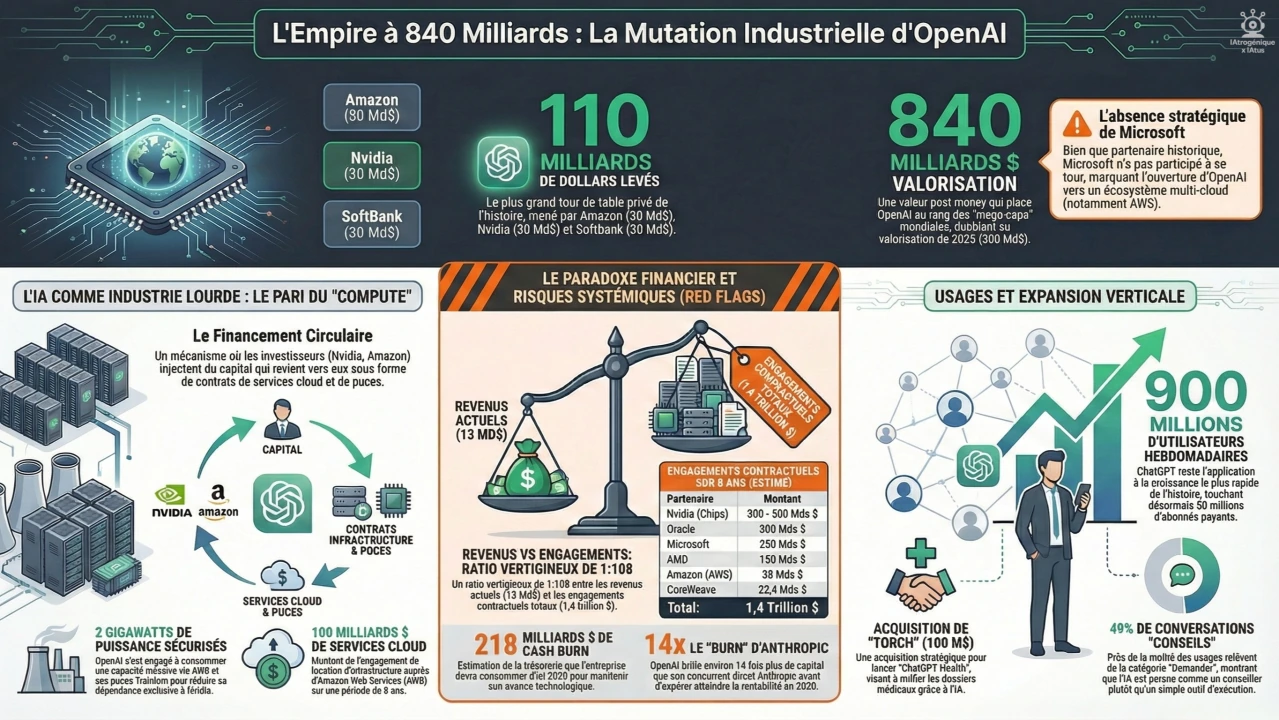
28 February 2026 will be remembered as the day Artificial Intelligence ceased to be a "software industry" and became heavy infrastructure, comparable to railway networks or twentieth-century electrification.
A history lesson: From century-long debt to radical equity
A few weeks ago, Alphabet made an impression by issuing 100-year debt (a century bond).
A powerful symbolic gesture: in a technology world dominated by the short-term quarterly horizon, borrowing over a century was a declaration that the company would still be there, central and sovereign, in 2126. It was a bet on stability and the confidence of the bond markets. Today, OpenAI is changing the paradigm. Rather than taking on debt to reassure the markets, the company is "burning" venture capital at an unprecedented rate to build a closed economy. If Google's century bond was a sign of maturity, OpenAI's $110 billion is a battle cry: a signal that the race to AGI will be won through the physical saturation of the global market with computing power, rather than through margin optimisation.
1. Anatomy of a "mega-round": The circular ecosystem
This funding round is more than a simple cash injection. It is an industrial restructuring: Amazon ($50 billion): OpenAI secures massive access to AWS, including a commitment to consume 2 gigawatts of compute using Trainium chips. Amazon is no longer just a supplier; it becomes a foundational partner. Nvidia & SoftBank ($30 billion each): We are witnessing a fascinating financial circularity. The capital Nvidia invests in OpenAI flows straight back to Nvidia in GPU purchases. This is a self-sustaining loop that locks competitors out of the compute supply. • Amazon ($50 billion): OpenAI secures massive access to AWS, including a commitment to consume 2 gigawatts of compute using Trainium chips. Amazon is no longer just a supplier; it becomes a foundational partner. • Nvidia & SoftBank ($30 billion each): We are witnessing a fascinating financial circularity. The capital Nvidia invests in OpenAI flows straight back to Nvidia in GPU purchases. This is a self-sustaining loop that locks competitors out of the compute supply.
2. The financial paradox: $1.4 trillion in commitments
For a financial analyst, OpenAI's balance sheet is an aberration: $13 billion in revenue against nearly $1.4 trillion in contractual commitments over 8 years (including cloud and chip spending). Why this madness? Because OpenAI is applying a "network effect" strategy on an industrial scale: More compute = Better models. Better models = More users. More users = More revenue (B2B/API). • More compute = Better models. • Better models = More users. • More users = More revenue (B2B/API). The company is accepting colossal operating losses today (requiring it to burn through $218 billion in cash by 2029) to ensure that, in 3 years, no other entity will be able to catch up with its infrastructure lead.
3. The tactical pivot: Why healthcare?
The acquisition of the startup Torch for $100 million a few weeks ago is no incidental expense; it is a strategic key. By integrating Torch, OpenAI is targeting the "HealthTech" segment with the ChatGPT Health service. The barrier to entry in healthcare is regulatory rather than technological. By developing the capabilities to sign BAAs (Business Associate Agreements), OpenAI becomes HIPAA-compliant. It is no longer a chatbot for the general public; it is a clinical infrastructure tool capable of processing sensitive health data. For OpenAI, this opens the door to recurring revenue (enterprise SaaS) that is infinitely more stable and lucrative than the consumer segment.
4. A stark comparison with Anthropic
While OpenAI plays the "Titan", absorbing capital to saturate the space, Anthropic is adopting a strategy of surgical precision, focused on reliability and secure deployment for regulated industries.
Conclusion: The rise of the new Titans
We are past the "AI startup" phase. We are witnessing the birth of what will, in twenty years, be the backbone of the global economy. If Alphabet, with its 100-year debt, built the search engine that structured information, OpenAI is building the "connective tissue" of automated decision-making. The $110 billion funding round is about building the foundations of tomorrow's giants, rather than creating an application. These companies will be judged on their ability to become the utilities of the algorithmic age, rather than on their immediate profits. We are building the "Standard Oils" or "Bell Labs" of the twenty-first century. And you—are you ready for this massive industrialisation of intelligence? #OpenAI #TechStrategy #Finance #IA #110Billion #DigitalInfrastructure #HealthTech
Text retrieved from the original publication on 21 October 2026. The information should be read in the context of its publication date. Original links and media are available on LinkedIn.
Continue with the full collection · Sources, translations and editorial approach.